

Written by Dr. med. Hind Hlali
German-licensed, board-certified specialist physician. Physician-led medical coordination in Germany.
Not a booking agency.
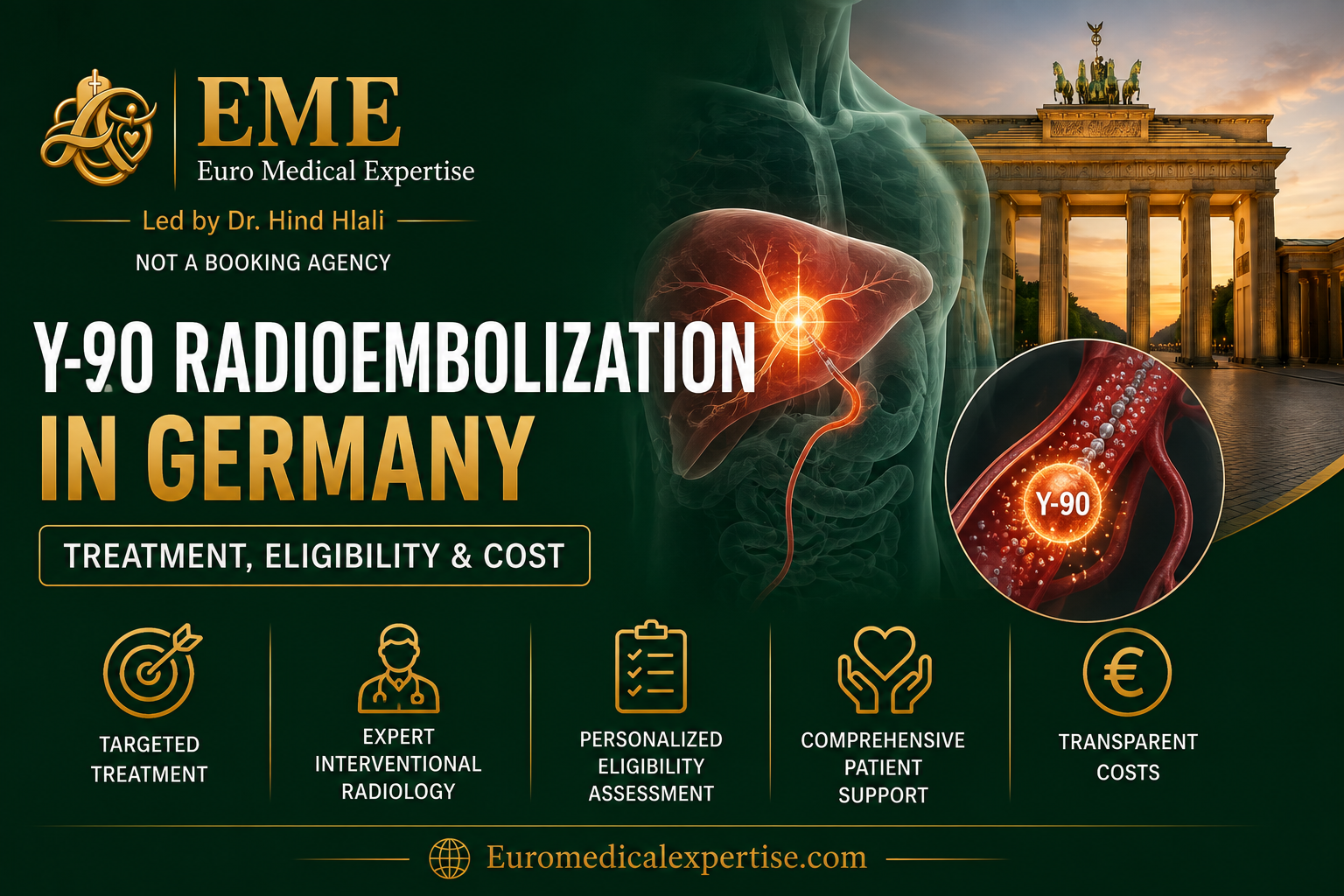
Y-90 Radioembolization in Germany: Treatment, Eligibility & Cost
Liver-directed targeted radiation, mapping angiography, dosimetry and patient selection.
Y-90 Radioembolization in Germany is a catheter-based liver treatment that delivers radioactive microspheres through the hepatic arteries to selected primary liver tumors or liver-dominant metastases.
The procedure requires mapping, radiation planning and assessment of liver reserve. It is not a general treatment for all stage 4 cancers and should be compared with surgery, ablation, systemic therapy and external-beam radiation.
This guide explains indications, mapping, dosimetry, procedure, risks, response assessment, cost and international patient pathways.
8 Helpful Facts About Y-90 Radioembolization in Germany
- Y-90 is a liver-directed treatment. Radioactive microspheres are delivered through the hepatic arterial circulation to selected tumors in the liver.
- It is not suitable for every liver tumor. Tumor type, liver reserve, disease distribution, vascular anatomy and extrahepatic disease all influence eligibility.
- Mapping comes before treatment. Angiography is used to evaluate arterial anatomy and reduce the risk of non-target microsphere delivery.
- Lung shunt assessment matters. Excessive shunting can affect safety and treatment planning.
- Dosimetry is individualized. The planned activity should reflect tumor burden, treatment territory and normal-liver tolerance.
- Y-90 can be compared with other liver-directed strategies. Depending on the diagnosis, alternatives can include surgery, ablation, TACE, systemic treatment or external-beam radiation.
- Response assessment takes time. Imaging after radioembolization can show treatment-related changes that require experienced interpretation.
- There is no universal fixed package price. International patients should request an official German hospital estimate after medical review and treatment planning.
What Y-90 Radioembolization in Germany Is
Y-90 radioembolization is a liver-directed treatment that delivers radioactive microspheres through the hepatic arterial circulation. The microspheres lodge preferentially in tumor-feeding vessels and emit beta radiation over a limited range.
It is also called selective internal radiation therapy, or SIRT. It is different from external-beam radiation and conventional transarterial chemoembolization.
Y-90 Radioembolization in Germany requires collaboration between interventional radiology, nuclear medicine and disease-specific oncology.
Why the Hepatic Artery Is Used for Y-90
Many liver tumors receive a substantial share of their blood supply from the hepatic artery, while normal liver tissue also receives portal venous blood flow.
Radioembolization uses this difference to deliver radiation selectively to tumor-bearing liver regions.
Careful angiography and dosimetry are necessary because non-target microspheres can injure stomach, bowel, gallbladder or other tissues.
Which Cancers May Be Considered for Y-90?
Y-90 can be considered in selected hepatocellular carcinoma and liver-dominant metastatic disease, including certain colorectal and neuroendocrine cancer settings.
The role depends on tumor type, liver function, distribution of disease, previous systemic treatment and whether surgery, ablation or external-beam radiation are better options.
The presence of liver metastases alone does not automatically make a patient eligible.
Y-90 for Hepatocellular Carcinoma
In hepatocellular carcinoma, radioembolization can be used as a liver-directed option for selected patients. Radiation segmentectomy, lobar treatment or other individualized approaches may be considered according to tumor distribution.
Treatment selection should take place in a liver tumor board because resection, transplantation, ablation, systemic therapy and other arterial treatments can compete or complement one another.
Underlying cirrhosis and liver reserve are as important as tumor anatomy.
Y-90 for Liver Metastases
For liver metastases, Y-90 is most relevant when liver disease is a major driver of prognosis or symptoms and the overall treatment strategy supports a liver-directed approach.
Extrahepatic progression can limit the value of treating the liver alone. Systemic therapy remains essential in many metastatic cancers.
Colorectal and neuroendocrine metastases have different evidence and sequencing considerations.
Mapping Angiography Before Y-90
Before treatment, the interventional team evaluates hepatic arterial anatomy and identifies vessels that could carry microspheres to non-target organs.
Mapping can include angiography and a nuclear-medicine simulation study to estimate distribution and shunting.
Findings can change the treatment plan, require vessel management or occasionally make radioembolization unsafe.
Lung Shunt Assessment Before Y-90 in Germany
Some arterial flow can bypass the liver and reach the lungs. Excessive shunting can expose lung tissue to radiation.
Pre-treatment nuclear-medicine assessment helps estimate this risk and contributes to activity planning.
The final decision follows the center’s dosimetry method and the patient’s anatomy rather than a single universal cut-off applied without context.
Personalized Dosimetry for Y-90
Modern radioembolization increasingly emphasizes absorbed-dose calculation for tumor and normal liver.
Dose planning can help balance tumor control against liver toxicity and is a major part of contemporary EANM procedural guidance.
International patients can ask whether the center uses patient-specific dosimetry and how treatment delivery is verified.
How Y-90 Radioembolization in Germany Is Delivered
A catheter is advanced through an artery, usually from the wrist or groin, into selected hepatic branches. The Y-90 microspheres are then infused into the planned liver territory.
Treatment can be segmental, lobar or staged depending on disease distribution and liver reserve.
The patient is monitored after the procedure according to the center’s interventional and radiation-safety protocol.
Radiation Segmentectomy and Lobar Y-90 Treatment
Radiation segmentectomy aims to deliver an ablative radiation dose to a limited liver segment containing tumor. Lobar radioembolization treats a larger territory.
The choice depends on number and size of tumors, vascular anatomy, treatment goal and how much healthy liver must be preserved.
Staged treatment can be used when treating both lobes at once would create excessive liver risk.
Potential Benefits and Limits of Y-90
Y-90 can achieve local tumor control and in selected situations may help downstage disease, bridge to another treatment or control liver-dominant progression.
Expected benefit must be considered in the context of disease outside the liver. Treating one organ cannot compensate for uncontrolled systemic progression.
Patients should ask what outcome the team expects: local control, symptom relief, downstaging or another defined objective.
Risks and Side Effects of Y-90
Common post-treatment symptoms can include fatigue, low appetite, nausea, abdominal discomfort and low-grade fever.
More serious complications include radiation-induced liver injury, biliary damage, ulceration from non-target delivery and rare clinically important lung exposure.
Baseline cirrhosis, prior liver treatments and limited liver reserve can increase risk.
Y-90 and Systemic Therapy
Timing with chemotherapy, targeted therapy or immunotherapy requires individualized planning because drugs can affect liver function, marrow reserve or procedural risk.
The oncology team should define which medicines are held, continued or restarted and when response imaging will be performed.
Y-90 is often one component of a multimodal strategy rather than a replacement for systemic treatment.
When the broader cancer plan includes systemic treatment, patients can also review Chemotherapy in Germany and Immunotherapy in Germany. For selected liver lesions or other disease sites, Radiation Therapy in Germany may also be relevant. The treating team decides how each option fits the complete oncology strategy.
Y-90 vs TACE and External Radiation
TACE delivers chemotherapy with embolic material, while Y-90 delivers radiation with microspheres. External-beam techniques such as stereotactic radiation treat selected targets from outside the body.
No one method is universally superior. Portal-vein status, tumor distribution, liver function, prior treatment and center expertise influence selection.
A multidisciplinary comparison is useful when more than one liver-directed option is technically possible.
Response Assessment After Y-90
After radioembolization, treatment effect may appear as necrosis or reduced enhancement before the tumor decreases in size.
Follow-up can use CT, MRI, PET or tumor markers according to the cancer type.
Imaging should be interpreted by teams familiar with post-radioembolization changes so viable tumor is not confused with expected treatment effect.
Choosing a Y-90 Center in Germany
A high-quality program combines interventional radiology, nuclear medicine, dosimetry and access to hepatology or liver oncology when needed.
Patients should ask how mapping and activity planning are performed, how liver reserve is assessed and how non-target radiation risk is minimized.
The center should also explain what alternative liver-directed treatments were considered.
Remote Review Before Y-90 Treatment
For Y-90 Radioembolization in Germany, international patients should begin with a focused medical review before arranging travel. Useful records include multiphase liver CT or MRI, pathology, systemic-treatment history, current liver-function tests and information about extrahepatic disease.
A remote opinion can clarify whether the requested treatment is medically plausible, what information is missing, and whether another established therapy should come first. It does not guarantee treatment acceptance by a German center.
Jaundice, acute infection, uncontrolled bleeding or rapidly worsening liver failure requires urgent local assessment rather than elective travel.
Y-90 Radioembolization in Germany for International Patients
International care requires more than hospital admission. Patients should understand the number of visits, expected monitoring, recovery needs and how complications will be handled after they leave Germany. The pathway usually includes mapping before treatment, and some patients require staged treatment of more than one liver territory.
A written discharge and follow-up plan should identify which tests can be performed in the home country, which results must be sent back to Germany and which symptoms require urgent local assessment.
Medical reports, imaging and pathology generated in Germany should be provided to the home-country team to support continuity of care.
Y-90 Radioembolization in Germany for Patients From the United States
US patients may seek a German interventional oncology and nuclear medicine opinion for a difficult eligibility question, treatment sequencing, access to a specialized center or an independent review of imaging and pathology.
Advanced oncology care is also widely available in the United States, so international travel should have a specific clinical rationale rather than a general assumption that one health system is always better.
When treatment is delivered in Germany, the home oncologist should receive the German plan and know how post-treatment monitoring will be shared.
Y-90 Radioembolization in Germany for Patients From Saudi Arabia and the Gulf
Patients from Saudi Arabia, UAE, Qatar, Kuwait, Bahrain and Oman can often start with remote case review. A concise timeline of diagnosis and prior treatment helps the German team assess the case efficiently.
Government-sponsored cases may require formal medical acceptance, an official hospital estimate and documentation explaining why the proposed treatment is indicated.
Family support, accommodation and travel timing should be planned according to the medical pathway rather than a fixed tourist-style schedule.
Cost of Y-90 Radioembolization in Germany
There is no single fixed price for Y-90 Radioembolization in Germany. Cost depends on specialist review, mapping angiography, nuclear-medicine planning, dosimetry, the treatment territory, the Y-90 procedure itself, imaging, laboratory monitoring and whether treatment is staged or repeated.
Y-90 Radioembolization in Germany Cost: What Can Be Included?
For international self-paying patients, the official estimate should follow medical review because the required mapping, treatment territory, dosimetry and number of procedures vary between patients.
| Cost component | What it may include | Why the cost varies |
|---|---|---|
| Specialist review | Oncology, interventional radiology and nuclear-medicine assessment | Complexity of diagnosis and prior treatment |
| Mapping angiography | Arterial mapping, catheter planning and vessel assessment | Vascular anatomy and technical complexity |
| Lung shunt / nuclear imaging | Assessment of extrahepatic distribution and pulmonary shunting | Center protocol and planning requirements |
| Dosimetry | Calculation of planned activity and treatment territory | Tumor burden, liver volume and treatment strategy |
| Y-90 procedure | Catheter-based delivery of radioactive microspheres | Single territory versus staged treatment |
| Laboratory monitoring | Liver function, blood counts and other treatment-specific tests | Baseline liver reserve and follow-up needs |
| Follow-up imaging | CT, MRI or PET-based assessment when indicated | Tumor type and timing of response assessment |
| Additional oncology treatment | Systemic therapy or other liver-directed treatment when separately indicated | Y-90 may be only one part of the overall treatment plan |
Why We Do Not Publish a Fixed Y-90 Package Price
A generic package can be misleading because one patient may need a single selective treatment while another requires staged treatment of different liver territories. The cost of Y-90 Radioembolization in Germany should therefore be based on the proposed hospital plan after imaging and mapping have been reviewed.
Can International Patients Receive an Official Estimate Before Travel?
Yes. After the medical file and imaging have been reviewed and a German center has defined the likely mapping and treatment pathway, an official hospital estimate can usually be requested. This is useful for self-paying patients from the United States, Saudi Arabia, UAE, Qatar, Kuwait, Bahrain and Oman, as well as for government-sponsored cases.
Need an official estimate for Y-90 Radioembolization in Germany?
Send pathology, recent liver imaging, treatment history and current laboratory results first. The estimate should reflect the proposed German hospital plan rather than a generic online package.
Send Your Medical Case WhatsApp Dr. HindSecond Opinion Before Y-90 Radioembolization in Germany
A second opinion is most useful when it answers a defined question: eligibility, treatment sequence, interpretation of imaging or pathology, the role of a specialized technique, or the balance between expected benefit and treatment burden.
A high-quality second opinion may confirm the original recommendation. The purpose is a better-supported decision, not simply a different answer.
The final treatment decision remains with the German treating team after its own review and, when necessary, direct assessment.
Baseline liver reserve is one of the most important determinants of safety. Bilirubin, albumin, coagulation, ascites and portal-hypertension features help the team understand how much healthy liver function is available. A technically successful catheter procedure can still be unsafe if the remaining liver cannot tolerate the radiation burden.
Prior liver surgery can alter both arterial anatomy and functional reserve. A patient who has had a major hepatectomy, repeated ablation or previous embolization needs individualized planning because the amount and distribution of normal liver are different from those of an untreated liver.
Portal-vein thrombosis does not automatically lead to the same decision in every patient. Radioembolization has different embolic characteristics from conventional TACE, but portal flow, tumor anatomy and hepatic reserve still require careful multidisciplinary review.
Biliary obstruction or previous biliary intervention can increase infection concerns. Drainage, stents or altered anatomy should be communicated before mapping. The interventional team may need to coordinate antibiotics, drainage management or another liver-directed strategy depending on the situation.
Dosimetry is not only a physics calculation; it connects treatment planning with the biological goal. Delivering too little radiation can reduce the chance of tumor control, while excessive normal-liver dose can increase toxicity. The balance depends on whether treatment is segmental, lobar or directed to multiple territories.
Radiation segmentectomy is particularly relevant when a small number of lesions can be treated within a limited arterial territory. It can function more like an ablative local therapy than whole-liver treatment in carefully selected patients. The patient should still be compared with resection and thermal ablation where appropriate.
After Y-90, fatigue and appetite changes can continue for days or weeks even when there is no major complication. Patients should receive instructions about fever, worsening abdominal pain, jaundice, black stools or persistent vomiting because these symptoms require timely medical review.
Imaging timing matters. Very early scans can show inflammatory or perfusion-related changes that are difficult to interpret. The treating team should specify when the first meaningful response assessment is expected and which modality is preferred for the tumor type.
If disease is present outside the liver, the oncology team should define how systemic therapy continues. Local liver control can be valuable, but survival may still be determined by extrahepatic progression. This is why radioembolization decisions belong in a multidisciplinary cancer plan rather than a procedure-only consultation.
Patients comparing hospitals should ask whether mapping, nuclear-medicine calculation and treatment are performed by the same integrated team. Fragmented planning can make communication more difficult, whereas coordinated interventional radiology and nuclear medicine is central to modern Y-90 practice.
Conclusion: Y-90 Radioembolization in Germany Is a Liver-Directed Strategy
Y-90 Radioembolization in Germany can be valuable for selected liver tumors, but candidacy depends on liver reserve, vascular anatomy, disease distribution and the role of systemic therapy.
The strongest decision comes from multidisciplinary review rather than choosing a procedure based on the presence of liver metastases alone.
An official estimate should follow imaging review and mapping planning, not precede medical eligibility.
Additional Clinical Planning Points
Liver Reserve Is Central to Safety
The amount of functioning liver that remains after treatment is a major determinant of risk. Cirrhosis, portal hypertension, previous liver surgery, prior embolization and previous radiation can all reduce hepatic reserve. Laboratory results should therefore be interpreted together with imaging and clinical signs such as ascites rather than in isolation.
Portal Vein Thrombosis and Vascular Anatomy
Portal-vein thrombosis and unusual hepatic arterial anatomy can change which liver-directed treatments are feasible. Radioembolization may still be considered in selected patients, but the decision requires careful angiographic planning. Previous arterial procedures should be documented because they can alter collateral vessels and non-target flow.
Biliary Disease and Prior Surgery
Patients with biliary obstruction, biliary-enteric anastomoses or previous hepatobiliary surgery can have a different complication profile. The interventional and nuclear-medicine team should review these details before planning treatment and decide whether additional precautions, drainage or another approach is preferable.
When a Staged Approach Is Used
When both liver lobes require treatment, centers may treat them in separate sessions to reduce the amount of normal liver exposed at one time. The interval and sequence depend on liver function, tumor distribution and dosimetry. International patients should know whether the quoted estimate and travel plan refer to one session or the complete staged pathway.
Interpreting Imaging After Y-90
A treated lesion may become necrotic without immediately becoming smaller. Enhancement patterns, metabolic activity and viable-tumor criteria can therefore be more informative than diameter alone in some settings. Follow-up scans should ideally be reviewed by radiologists familiar with post-radioembolization changes to avoid premature conclusions about failure.
Urgent Symptoms After Treatment
Increasing jaundice, severe abdominal pain, persistent vomiting, gastrointestinal bleeding, high fever or rapidly worsening weakness require prompt medical assessment. International patients should receive written contact instructions before leaving the center and should know where to seek emergency care after returning home.
Comparing Y-90 With Other Liver-Directed Options
A useful tumor-board discussion compares radioembolization with resection, ablation, external-beam radiation, TACE and systemic therapy where relevant. The preferred option depends on tumor number and location, liver reserve, extrahepatic disease and treatment goals. Technology should follow the clinical problem rather than drive it.
Travel and Radiation-Safety Instructions
After treatment, the nuclear-medicine and interventional teams provide practical instructions on hydration, activity, medication and radiation safety. The exact precautions depend on the isotope handling protocol and local rules. International patients should ask when commercial flying is medically reasonable and whether airport security documentation is needed, because small residual radioactivity can occasionally be relevant to radiation detectors.
Planning the Next Oncology Step
Radioembolization should have a defined place in the larger cancer plan. Before treatment, the team should decide when systemic therapy can restart, when liver imaging will be repeated and what response would trigger surgery, ablation, another liver-directed procedure or a change in systemic treatment. This prevents Y-90 from becoming an isolated procedure without a clear next step.
Functional liver volume matters as much as tumor volume. A patient with a large tumor in one lobe but a healthy opposite lobe may have a different risk profile from someone with diffuse bilobar disease and cirrhosis.
Mapping angiography can identify variant arterial anatomy, which is common in the liver. Understanding these branches helps the team deliver microspheres selectively and reduce non-target exposure.
Some patients undergo coil embolization or other vessel management during mapping, while other centers rely on highly selective catheter positioning. The technical approach should be explained in the context of the planned treatment territory.
Portal hypertension, ascites and low platelet counts can indicate limited hepatic reserve even when bilirubin is only mildly abnormal. These features should be considered before a high-dose liver-directed treatment.
For neuroendocrine liver metastases, symptoms from hormone secretion can complicate the picture. Radioembolization may be part of a broader plan that also includes somatostatin analogues, PRRT, surgery or other liver-directed treatment.
For colorectal metastases, prior chemotherapy can affect liver tissue and vascular health. The team should review cumulative treatment and whether systemic options remain active before deciding that liver-directed radiation is the best next step.
Radiation-induced liver disease is uncommon with careful selection and dosimetry but can be serious. Worsening ascites, jaundice or liver dysfunction after treatment requires prompt evaluation and cannot be managed as routine post-procedure fatigue.
Post-treatment planning should specify when systemic therapy resumes and who interprets the first response scan. This avoids conflicting advice when the interventional team and home oncologist use different follow-up schedules.
Laboratory trends before treatment can reveal deteriorating liver reserve even when a single value remains within a formal threshold. Rising bilirubin, falling albumin or worsening coagulation can signal that the window for safe liver-directed radiation is narrowing.
Patients with biliary-enteric anastomoses, prior Whipple surgery or repeated biliary stenting may have altered infection risk. The interventional team should know this history before mapping because antibiotic strategy and procedural planning may change.
Large central tumors can affect major bile ducts or vessels, while small peripheral tumors may be amenable to very selective treatment. The same total tumor size can therefore lead to different radioembolization strategies depending on location.
When radioembolization is used to bridge or downstage toward surgery or transplantation, the follow-up plan should define the criteria for the next step. Local control is useful only if it advances the broader treatment objective.
Radiation safety after Y-90 is generally manageable because most radiation is contained within the treated liver, but patients still receive specific instructions from the nuclear-medicine team. These instructions should be followed rather than generalized from another radionuclide therapy.
Persistent abdominal pain, gastrointestinal bleeding or severe nausea after treatment can indicate non-target injury and requires prompt assessment. Patients should know the warning symptoms before leaving the treating center.
A prior failed or technically difficult embolization does not automatically exclude future Y-90, but the original angiographic report can be important for understanding vascular anatomy and previous complications.
For international patients, the center should provide treatment documentation including the administered activity and treated liver territory. This information may be relevant if future external radiation, surgery or additional radioembolization is considered.
Patients should provide any previous radiation plans involving the liver because cumulative exposure can influence whether another radiation-based treatment is safe. Even when prior radiation was external rather than intra-arterial, the normal-liver dose may still matter.
Anticoagulation and antiplatelet therapy need review before arterial procedures. The interventional team decides whether medicines are continued, paused or adjusted based on bleeding and thrombotic risk; patients should not stop them independently.
After treatment, liver tests may change transiently, but persistent or progressive abnormalities require interpretation in context. The team must distinguish expected post-treatment changes from liver toxicity, biliary complications or cancer progression.
International patients should keep the angiography and dosimetry reports because future liver-directed therapy may depend on exactly which arterial territory and radiation activity were used.
The oncology team should document the intended next step after response assessment, whether that is continued systemic therapy, surgery, another liver-directed procedure or surveillance. This prevents radioembolization from becoming an isolated intervention without a defined place in the broader cancer plan.
You May Also Read
- Radioligand Therapy in Germany
- Radiation Therapy in Germany
- Stage 4 Cancer Treatment in Germany
- Cancer Treatment in Germany
- Targeted Therapy in Germany
- Oncology Tumor Board Solutions
- Expert Medical Second Opinion
- Medical Treatment Costs in Germany
Frequently Asked Questions
Is Y-90 radioembolization surgery?
No. It is a catheter-based interventional radiology and nuclear-medicine treatment.
Is Y-90 the same as TACE?
No. Y-90 delivers radiation with microspheres, while TACE combines arterial chemotherapy with embolization.
Which cancers can be treated?
Selected primary liver cancers and some liver-dominant metastases may be considered, depending on the clinical setting.
Do I need mapping before treatment?
Yes. Mapping angiography and nuclear-medicine assessment are important parts of planning.
What is lung shunting?
It is passage of arterial flow from the liver toward the lungs, which can expose lung tissue to radiation if excessive.
Can both liver lobes be treated?
Sometimes, often in staged sessions depending on liver reserve and disease distribution.
How is response checked?
Follow-up imaging and laboratory tests are used. Size alone may not reflect early treatment effect.
Can Y-90 be combined with systemic therapy?
Yes in selected pathways, but timing and safety must be planned by the treating team.
Is Y-90 curative?
It can be used with ablative intent in selected localized situations, but many uses are for disease control. A cure cannot be promised.
What records are needed?
Recent liver CT or MRI, pathology, treatment history and liver-function results are usually essential.
Can international patients receive Y-90 radioembolization in Germany?
Potentially, yes. A German interventional oncology and nuclear medicine team must review the diagnosis, prior treatment, current condition and medical indication before confirming treatment.
Can I send my medical records before traveling?
Yes. Remote review can often clarify whether an in-person consultation or treatment is justified. Original imaging, pathology and a chronological treatment history are especially useful.
Can I receive a German hospital cost estimate before travel?
Usually after the responsible center has reviewed the case and defined the likely treatment pathway. The estimate can change if the medical plan changes after direct assessment.
Are treatment results guaranteed?
No. Response and outcomes depend on disease biology, burden, previous therapy, organ function and many other factors. Responsible oncology care cannot guarantee a result.
Who makes the final treatment decision?
The treating German center and its multidisciplinary team make the final clinical decision after reviewing the complete case.
FAQ for Patients from the United States
Can US patients send their case for Y-90 Radioembolization in Germany before traveling?
Yes. US patients can usually begin with remote review of pathology, recent liver imaging, previous cancer treatment and current liver-function results. The purpose is to clarify whether a German interventional-radiology and nuclear-medicine review is medically relevant before travel. The treating German center makes the final treatment decision.
What documents should a US patient send before Y-90 Radioembolization in Germany?
Useful records usually include pathology, recent contrast-enhanced liver CT or MRI, radiology reports, previous treatment history, current medications and recent laboratory results including liver function. Prior interventional-radiology reports should also be included when available.
Can a US patient get a second opinion on Y-90 Radioembolization in Germany without committing to treatment?
Yes. A second opinion can compare Y-90 with surgery, ablation, TACE, systemic therapy or external-beam radiation and clarify whether liver-directed treatment fits the overall oncology plan.
Can US patients receive an official hospital estimate before traveling for Y-90 Radioembolization in Germany?
An official estimate can usually be requested after medical review. Mapping angiography may still change the final technical plan, so the estimate should be understood in relation to the proposed treatment pathway.
Can follow-up after Y-90 Radioembolization in Germany continue in the United States?
Often, laboratory monitoring, oncology review and follow-up imaging can continue with the patient’s US team. The German treating team should specify the timing and type of imaging needed to assess response.
FAQ for Patients from Saudi Arabia and the Gulf
Can patients from Saudi Arabia, UAE, Qatar, Kuwait, Bahrain and Oman be evaluated for Y-90 Radioembolization in Germany?
Yes. Gulf patients can be evaluated by German centers with expertise in interventional radiology and nuclear medicine. Suitability depends on tumor type, liver function, disease distribution, vascular anatomy and the role of Y-90 within the complete cancer strategy.
Can Gulf patients send imaging before traveling for Y-90 Radioembolization in Germany?
Yes. Remote review can usually begin with pathology, recent liver imaging, previous treatment records and laboratory results. Mapping angiography itself is generally performed as part of the German treatment pathway if the center considers Y-90 appropriate.
Can Saudi or UAE government-sponsored patients obtain an estimate for Y-90 Radioembolization in Germany?
An official hospital estimate can usually be requested after medical review. Sponsored cases may require formal acceptance and administrative documents from the receiving hospital. Euro Medical Expertise can support medical coordination and communication, while authorization and payment decisions remain with the sponsor and hospital.
Can Arabic medical documents be translated for Y-90 review in Germany?
Yes. If medical reports are available only in Arabic, Euro Medical Expertise can support translation and medical coordination so documents can be prepared in English or German when required by the receiving German hospital or specialist team. Exact translation requirements depend on the center and document type.
Can follow-up after Y-90 Radioembolization in Germany continue in Saudi Arabia, UAE or another Gulf country?
Often, liver-function monitoring, oncology follow-up and response imaging can continue in the patient’s home country. The German treating team should specify the recommended schedule and whether any return visit is medically necessary.
Scientific and Official Sources
These sources are provided for scientific context. Individual eligibility and treatment sequencing must be determined by the treating team.
Language Support
Euro Medical Expertise supports international patients with multilingual medical coordination whenever needed, including communication in English, Arabic, German, and French.
Medical disclaimer: This article is for general information and does not replace diagnosis or medical advice from the treating team. Eligibility, treatment choice, timing, dosing, expected benefit and risk must be assessed individually.
© Euro Medical Expertise. All rights reserved.

Cost of Dendritic Cell Therapy (DCT) in Germany
Euro Medical Expertise · Physician-Led Medical Coordination Updated: September 2026 Cancer Treatment in Germany ›…
The Cost of Colon Cancer Treatment in Germany
Euro Medical Expertise · Physician-Led Medical Coordination Updated: September 2026 Cancer Treatment in Germany ›…

The Cost of Lung Cancer Treatment in Germany
The Cost of Lung Cancer Treatment in Germany: Expert Guide Euro Medical Expertise · Physician-Led…

Cost of Immunotherapy in Germany
Cost of Immunotherapy in Germany 2026 | Prices & Patient Guide EME · Euro Medical…

Cancer Surgery in Germany: Specialist Surgeons, Advanced Procedures, Cost & International Patients
Written by Dr. med. Hind Hlali German-licensed, board-certified specialist physician. Physician-led medical coordination in Germany.Not…
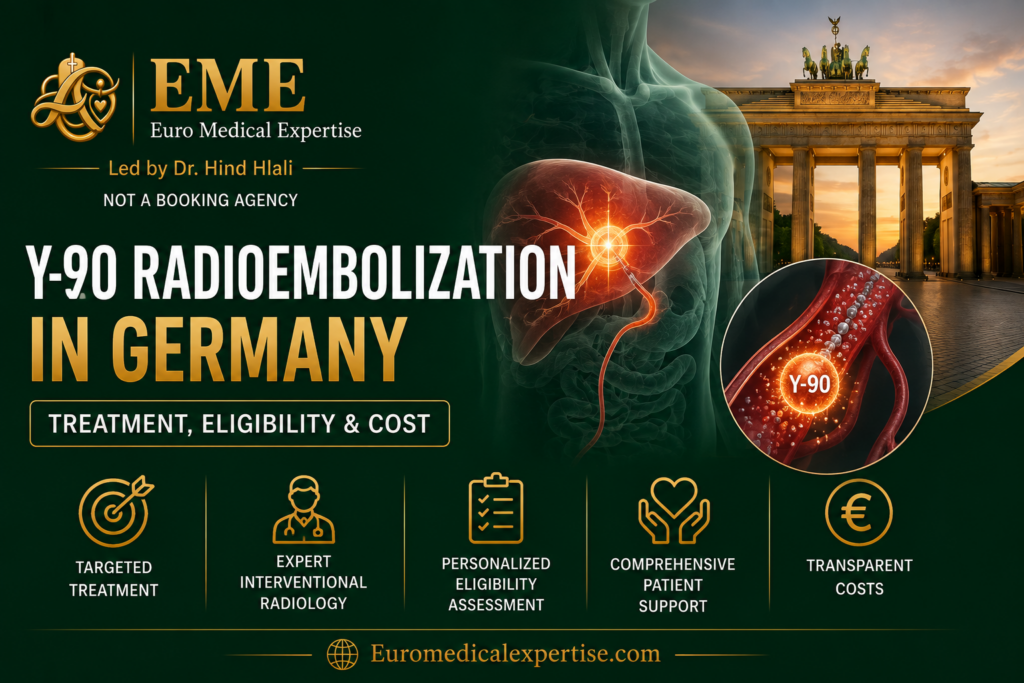
Y-90 Radioembolization in Germany: Treatment, Eligibility & Cost
Written by Dr. med. Hind HlaliGerman-licensed, board-certified specialist physician. Physician-led medical coordination in Germany.Not a…




Leave a Reply